Rev1 ABS Conductive The ESD-Safe, Static-Dissipative Conductive ABS
The ESD-Safe, Static-Dissipative Conductive ABS
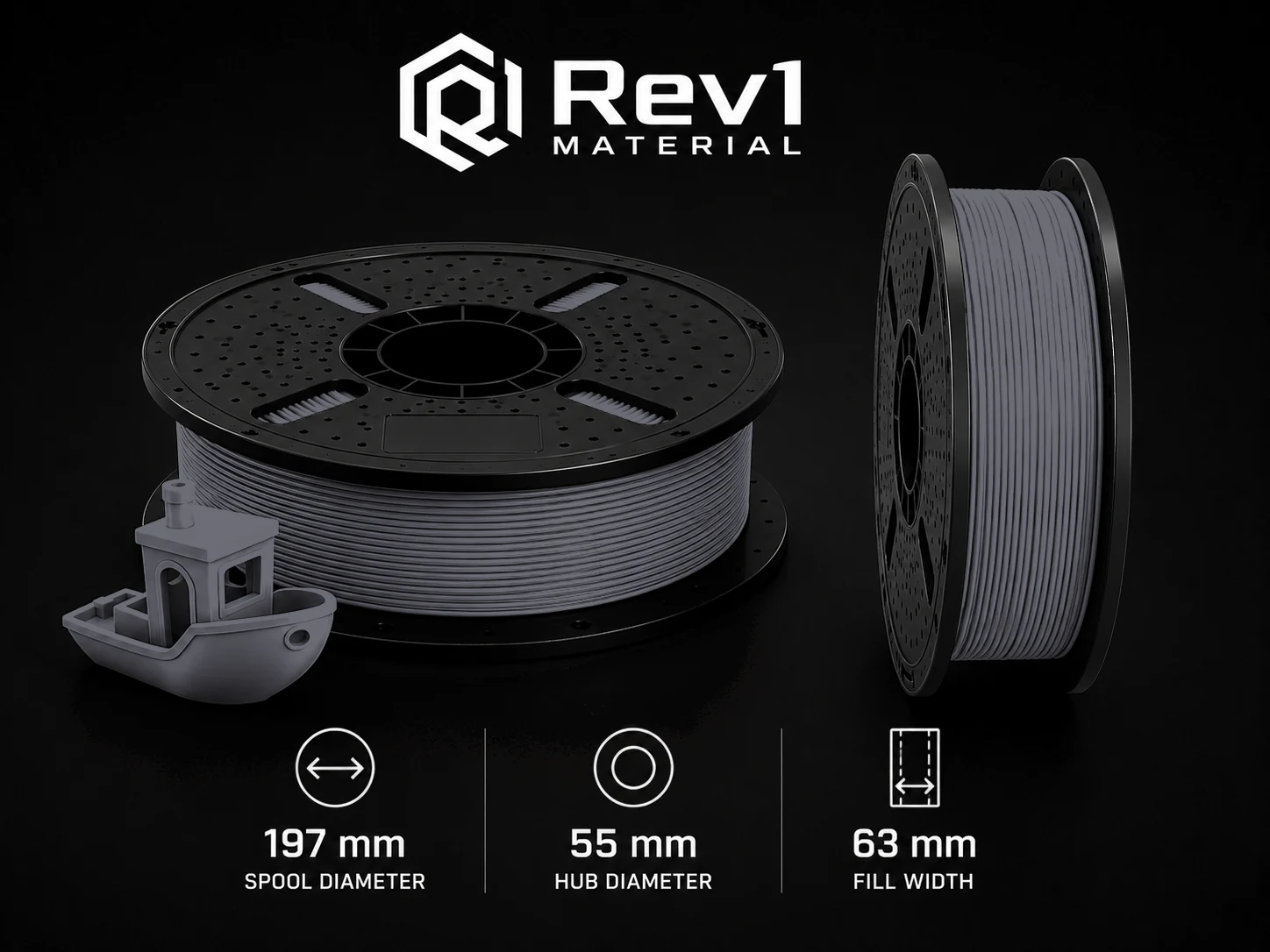
Rev1 ABS Conductive is a carbon-loaded ABS that is electrically conductive and static-dissipative — the go-to filament for handling and housing static-sensitive electronics. It keeps ABS toughness and heat resistance in a matte Conductive Black finish, so charge dissipates safely instead of building up. Enclosed printer recommended — single Conductive Black, on 1 kg and 3 kg spools. Full specifications →
Made to order — ships from Rev1. Need a 3 kg spool, ESD/resistivity data, or case pricing? Call (248) 707-2950.
ESD-safe, vacuum-sealed, supported by humans.
Rev1 ABS Conductive is precision-extruded 1.75 mm static-dissipative filament, wound evenly and vacuum-sealed with desiccant, then made to order and supported from Auburn Hills, Michigan.

When static discharge is the thing you can’t risk.
Standard ABS is an insulator — it builds and holds a static charge that can zap sensitive electronics. Rev1 ABS Conductive is carbon-loaded so it is electrically conductive and static-dissipative, giving it controlled surface resistivity that safely bleeds off charge. You keep ABS toughness and heat resistance, in a matte Conductive Black finish — the material to reach for whenever static-sensitive components are in play. Like ABS, it prints best on an enclosed, draft-free printer.
Even diameter and a clean wind for reliable, warp-free runs.
Round, consistent 1.75 mm filament feeds smoothly so long enclosed prints don’t fail.
Every Rev1 ABS Conductive spool is wound evenly and held to a tight diameter, so it feeds without under-extrusion across a full 1 kg or 3 kg run. Vacuum-sealed with desiccant to arrive dry — critical for ABS, which prints best straight out of the bag.
Carbon loading bleeds off static charge safely — protecting the electronics you handle and house.
Keeps ABS heat tolerance — holds its shape near motors, drivers, and warm enclosures.
Impact-resistant ABS body — durable enough for real handling, trays, and fixtures.
A single, uniform matte-black conductive finish — no pigment, just consistent surface resistivity.
Print settings for clean, crack-free ABS Conductive.
ABS Conductive prints like ABS — it wants a stable, draft-free environment. An enclosure, a hot bed, and minimal part cooling keep corners down and layers bonded. The one difference: the carbon loading is mildly abrasive, so a hardened-steel nozzle is recommended.
Prints in the ABS range; use a hardened-steel nozzle — the carbon fill is mildly abrasive.
A hot bed plus glue or an adhesive sheet prevents the corners from lifting.
An enclosure holds chamber heat and blocks drafts — the #1 fix for warping and cracking.
ABS emits styrene odor while printing; run it in a ventilated space or with filtration.
Recommended slicer settings
A solid starting profile for Rev1 ABS Conductive on an enclosed FDM printer. Tune cooling and chamber temperature for your machine.
| Setting | Recommended | Notes |
|---|---|---|
| Nozzle temperature | 230–250 °C | Standard ABS range; run hot enough for strong layer bonding. |
| Nozzle type | Hardened steel | Recommended — the conductive carbon fill is mildly abrasive to brass. |
| Bed temperature | 90–110 °C | Glue stick or ABS slurry on glass/PEI for a strong first layer. |
| Chamber / enclosure | Warm, draft-free | The single biggest factor in warp- and crack-free ABS. |
| Print speed | 30–60 mm/s | Moderate speeds help interlayer strength. |
| Part cooling fan | 0–20 % | Keep cooling low — too much fan cracks layers. |
| Retraction | 1–5 mm | Direct drive: ~1–2 mm. Tune to control stringing. |
| Nozzle size | 0.4 mm + | 0.4 mm hardened is the sweet spot; larger adds strength on functional parts. |
| Drying | 65–80 °C · 4–6 h | Only if exposed to humidity; ABS is less hygroscopic than PETG. |
Parts that keep static off sensitive electronics.
The material behind static-safe electronics work.
ABS Conductive trades a little mechanical strength for what electronics work actually needs: controlled surface resistivity that safely dissipates static, plus ABS toughness and heat resistance. Made to order in matte Conductive Black, on 1 kg and 3 kg spools.
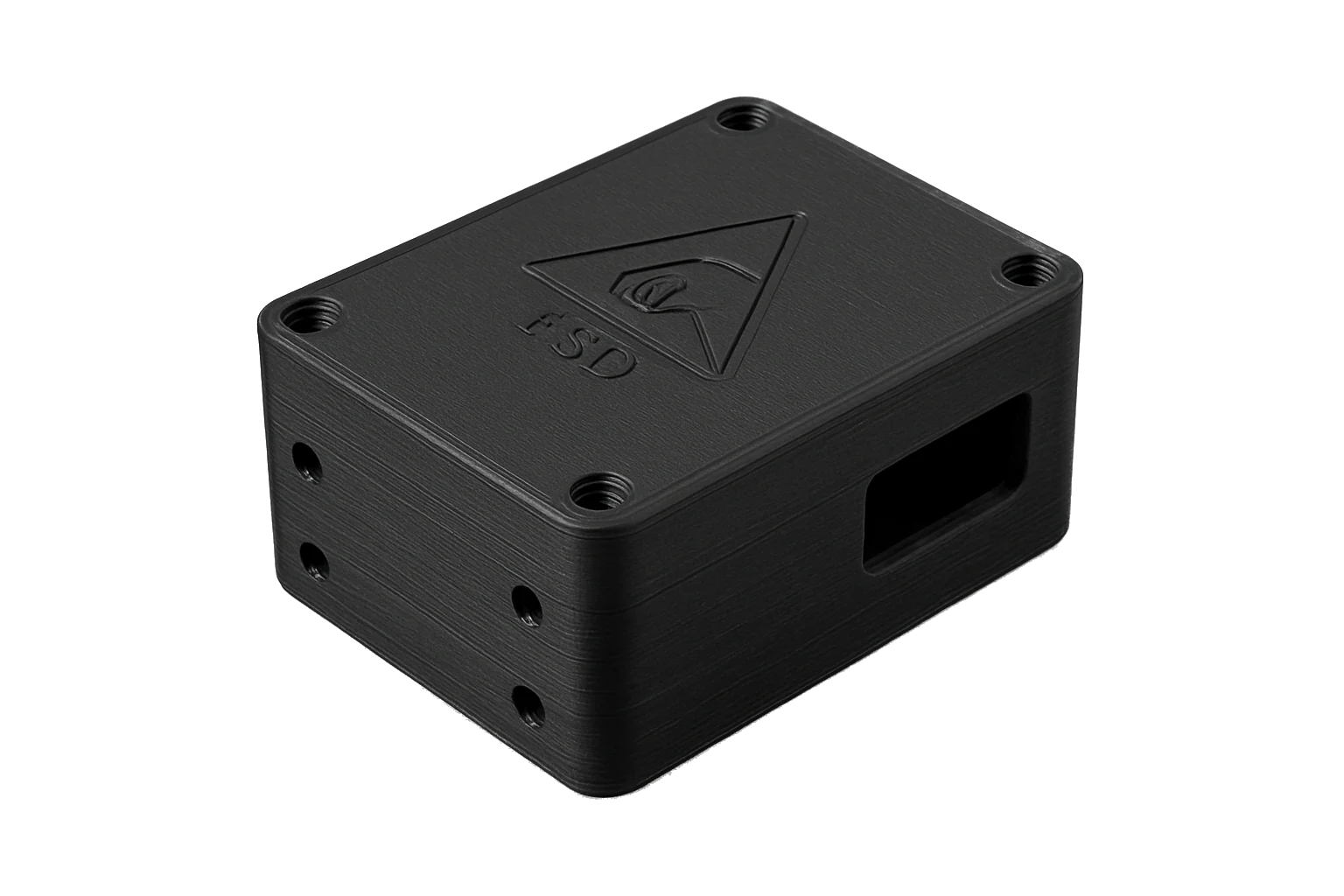
A static-safe home for bare circuit boards.
Static-dissipative walls bleed off charge before it reaches sensitive components.
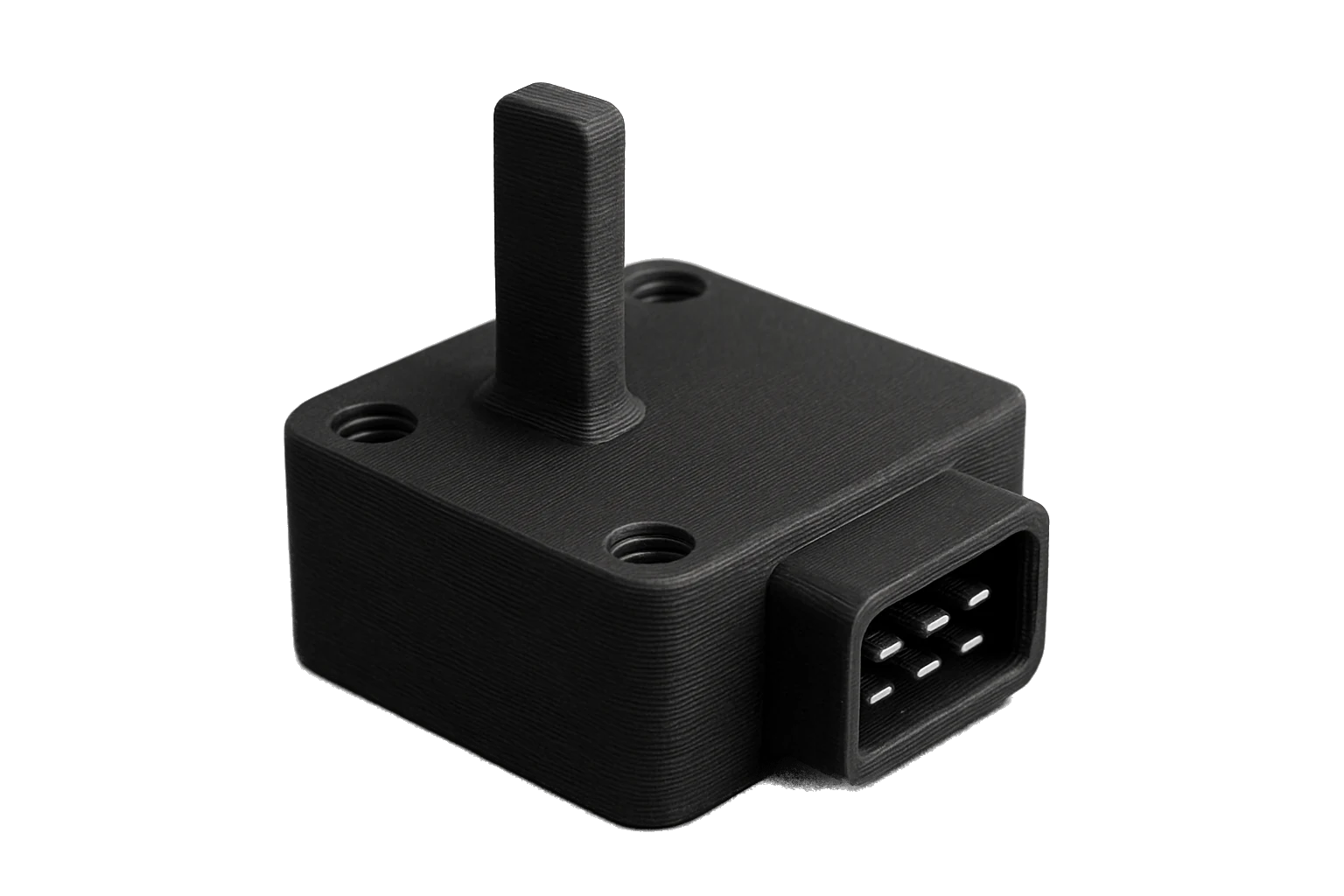
Enclosures and cases that house populated PCBs and control electronics — the conductive ABS body dissipates static instead of storing it, protecting the boards inside while keeping ABS toughness and heat tolerance.
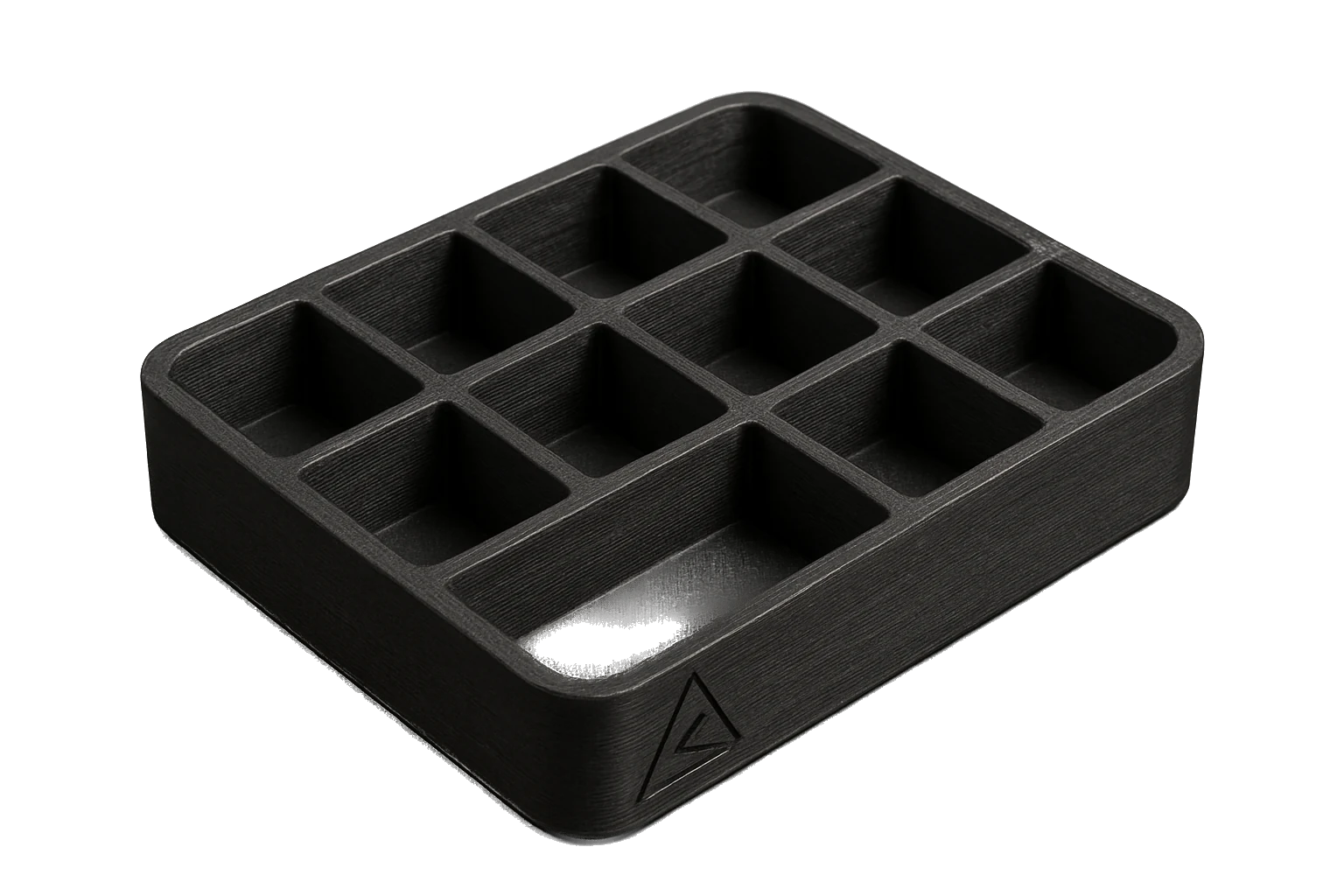
Trays and organizers that keep parts static-safe.
Static-dissipative bins for storing and sorting sensitive components.
Print custom-fit trays, dividers, and organizers for ICs, connectors, and small assemblies — the conductive ABS keeps stored parts at a safe potential instead of letting charge accumulate on the tray.
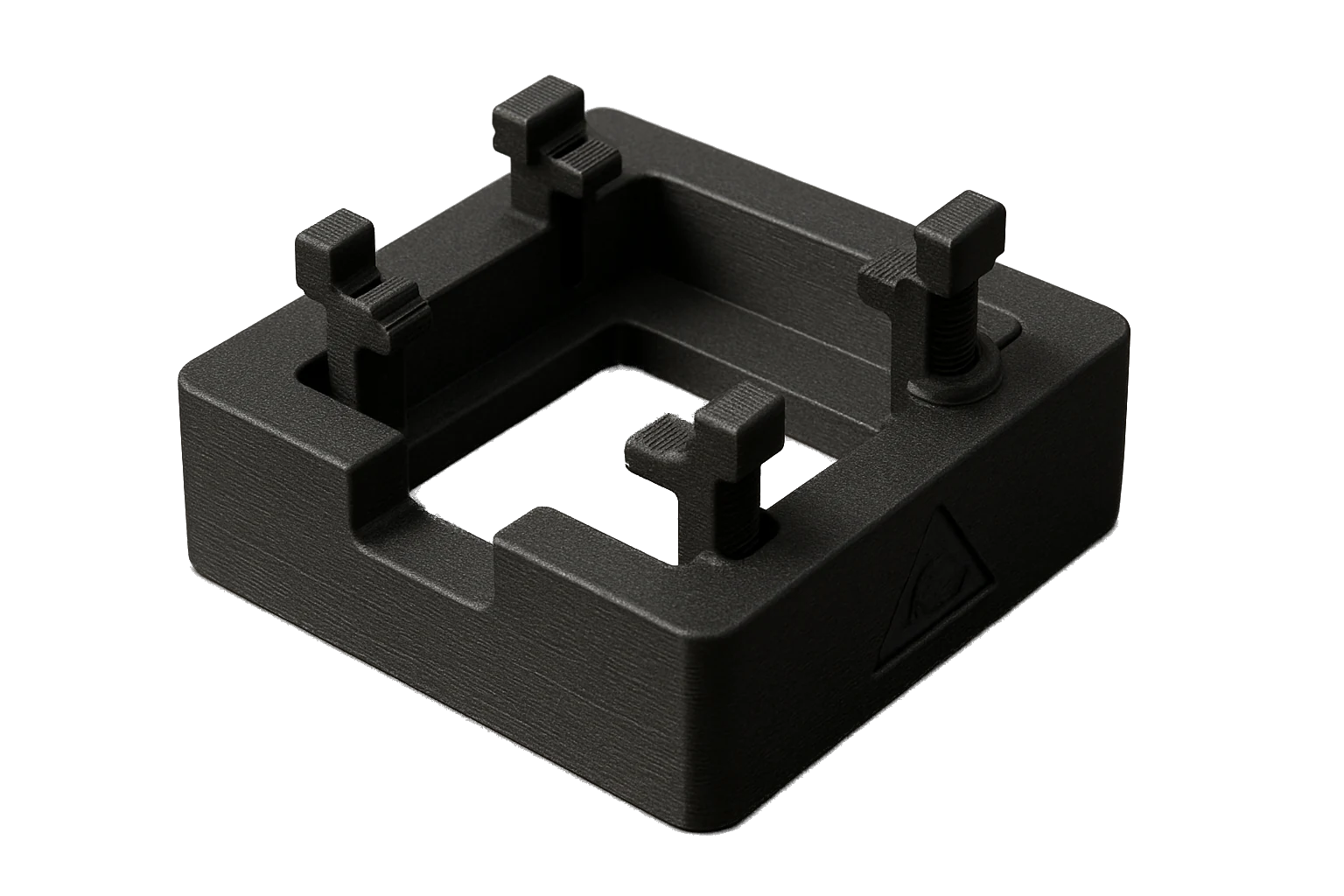
ESD-safe jigs for handling live components.
Static-dissipative fixtures that keep charge off parts during assembly.
Print the assembly jigs, nests, and handling fixtures your electronics line needs — ABS Conductive holds its shape through repeated cycles while dissipating static, so boards and components stay protected at the bench.
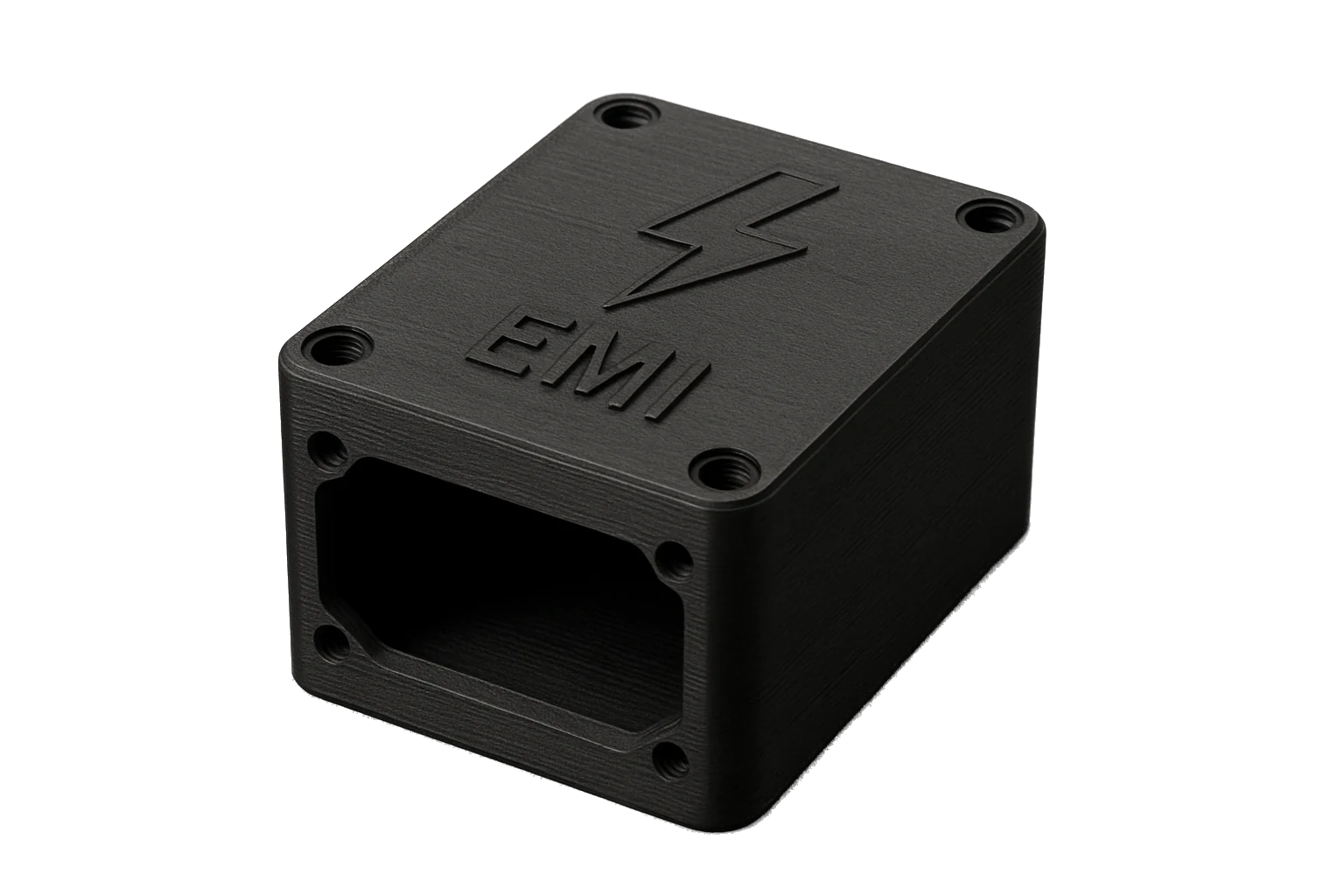
Conductive housings that help tame interference.
A conductive shell that supports EMI management around electronics.
Because the carbon fill makes the whole part conductive, ABS Conductive housings can help manage electromagnetic interference around sensitive circuitry — a conductive enclosure body you can print instead of adding separate shielding.
Grounded housings for connectors and sensors.
Conductive bodies where static control and grounding matter.
Connector shells, sensor housings, and cable-end covers benefit from a static-dissipative body — ABS Conductive keeps these small parts at a controlled potential so they don’t carry a charge into the circuits they connect to.
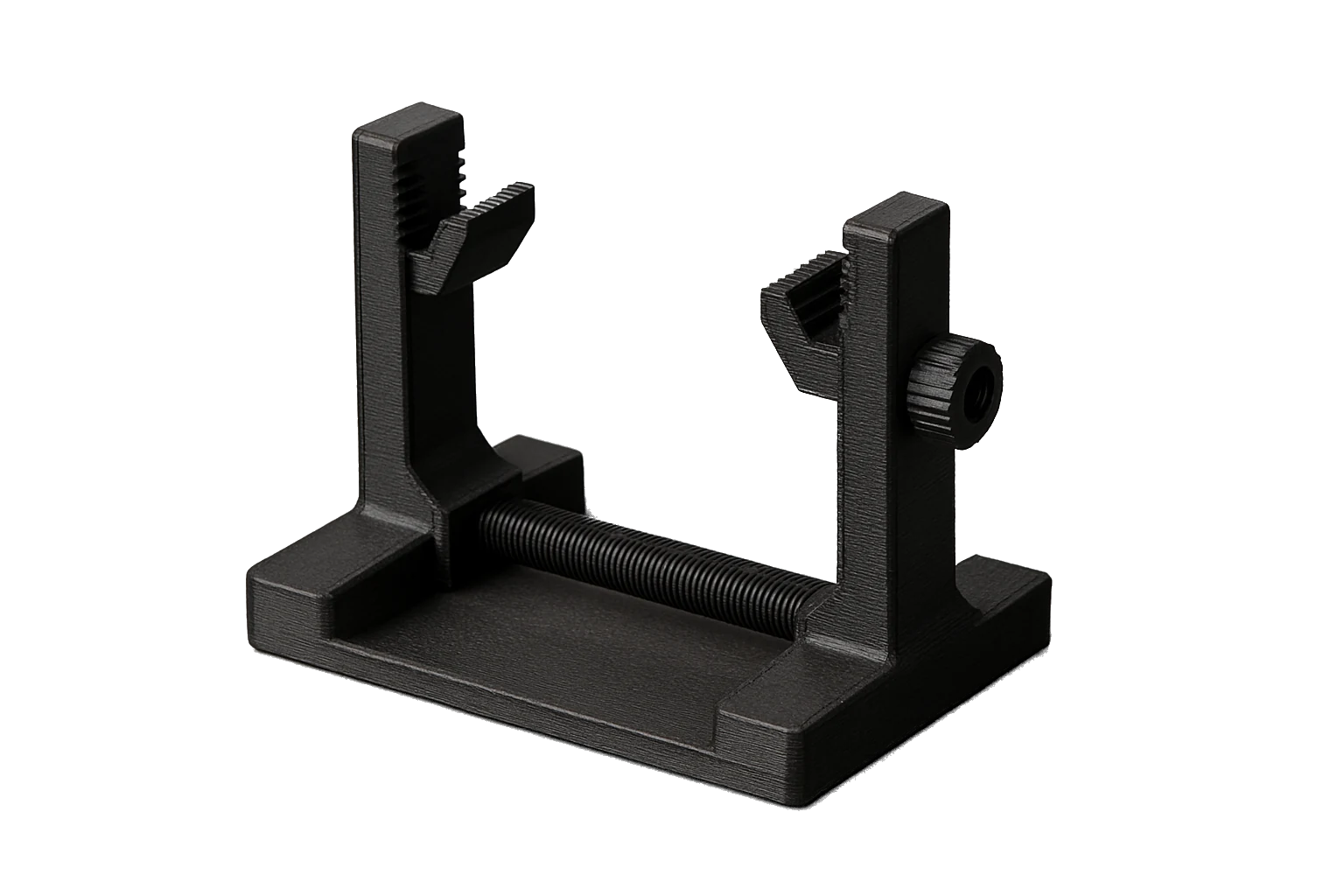
Anti-static holders that cradle bare boards.
Static-safe fixtures for working on and moving PCBs.
Bench cradles, edge holders, and transport fixtures for bare circuit boards — ABS Conductive keeps the board at a safe potential during rework, testing, and handling. Ask us about 3 kg spools and case pricing.
ABS Conductive vs. ABS vs. ABS-CF.
Pick by what the part has to do. ABS Conductive wins when static must be controlled; plain ABS wins on color choice and cost; ABS-CF wins on stiffness and strength.
| Rev1 ABS Conductive | ABS | ABS-CF | |
|---|---|---|---|
| Static control | Static-dissipative (ESD-safe) | Insulator — builds static | Insulator |
| Heat resistance | High (~90–100 °C) | High (~100 °C) | High (~100 °C) |
| Mechanical strength | Reduced (traded for conductivity) | Standard ABS | Highest — stiff, structural |
| Colors | Conductive Black only | Many colors | Black |
| Nozzle | Hardened recommended | Brass is fine | Hardened required |
| Best for | ESD / electronics | General functional | Stiff structural |
General material guidance; exact performance depends on part geometry, print settings, and grade. ABS Conductive is a specialty ESD material — for pure strength choose ABS-CF or PC, and for outdoor use choose ASA.
Rev1 ABS Conductive Technical Data
Mechanical & thermal properties
Typical values for engineering reference — the carbon loading that makes ABS Conductive static-dissipative also lowers mechanical strength versus standard ABS. Printed-part performance varies with wall count, infill, layer height, and orientation; treat these as material-level guidance, not a part spec.
| Property | Typical Value | Method |
|---|---|---|
| Surface resistivity | ~10⁴–10⁷ Ω/sq* | Static-dissipative range |
| Tensile strength | ~30 MPa* | ISO 527 |
| Elongation at break | ~6 %* | ISO 527 |
| Flexural strength | ~50 MPa* | ISO 178 |
| Izod impact (notched) | ~6 kJ/m²* | ISO 180 |
| Glass transition (Tg) | ~105 °C | DSC |
| Heat deflection (HDT, 0.45 MPa) | ~90–98 °C | ISO 75 |
| Shelf life (sealed, dry) | 12 months | — |
*Typical reference values for conductive/ESD-safe ABS — confirm surface resistivity and mechanicals against the TDS for your application.
Specs, profiles, and a human to call.
Your trusted materials partner.

Every spool is checked for tight diameter tolerance and reliable, repeatable printing.
Call (248) 707-2950 and reach people who actually print and support these materials.
Case quantities and standing orders of ABS Conductive, with ESD data on request.
FAQ
Rev1 ABS Conductive — Common Questions
What makes ABS Conductive “ESD-safe”?
It’s a carbon-loaded ABS, so the whole part is electrically conductive and static-dissipative. That controlled surface resistivity (typically the ~10⁴–10⁷ Ω/sq static-dissipative range) lets charge bleed off safely instead of building up — which is why it’s the go-to for handling and housing static-sensitive electronics.
Do I need an enclosure to print ABS Conductive?
Strongly recommended — it prints like ABS and warps and cracks when it cools unevenly or hits a draft. An enclosure holds chamber heat and blocks airflow, the single biggest factor in clean parts. A heated bed at 90–110 °C is also essential. Because the carbon fill is mildly abrasive, run a hardened-steel nozzle.
What colors and sizes are available?
A single color: matte Conductive Black — the carbon that makes it conductive also sets the color, so it isn’t offered in other shades. It ships on 1 kg and 3 kg spools. The 1 kg spool is $44.99. Pick your spool size in the buy-box, or ask us about case quantities.
How do I stop ABS Conductive from warping and cracking?
Enclose the printer, run a 90–110 °C bed with glue or ABS slurry, keep part cooling low or off, and avoid drafts and AC vents. Brims and a warm chamber help large flat parts stay stuck — the same discipline as standard ABS.
Is ABS Conductive safe to print indoors?
Like all ABS, it gives off a styrene odor while printing, so use it in a ventilated space or with an enclosure and filtration. Many users vent the enclosure outdoors or run a carbon/HEPA filter.
Is ABS Conductive a strong structural material?
No — it’s a specialty ESD material. The carbon loading trades some mechanical strength for conductivity, so it’s not a max-strength structural or high-heat grade. When you need pure strength, choose ABS-CF or PC; for outdoor/UV parts, choose ASA. Reach for ABS Conductive specifically when static control matters.
How heat-resistant is ABS Conductive?
It keeps ABS heat tolerance — roughly 90–100 °C (HDT ~90–98 °C), suitable for warm enclosures and near-motor or near-driver electronics. For sustained higher heat, step up to PC or PA (nylon).
What’s the lead time, and is the 3 kg spool better value?
ABS Conductive is made to order — typically 1–3 weeks. The 3 kg spool lowers cost per kilogram and means fewer spool changes on long or production runs, so it’s the go-to for busy electronics benches and lines.