3DXTech CarbonX™ PC+CF Carbon-Fiber Reinforced Polycarbonate — High Heat, High Stiffness, USA-Made
Carbon-Fiber Reinforced Polycarbonate Filament — High Heat, High Stiffness
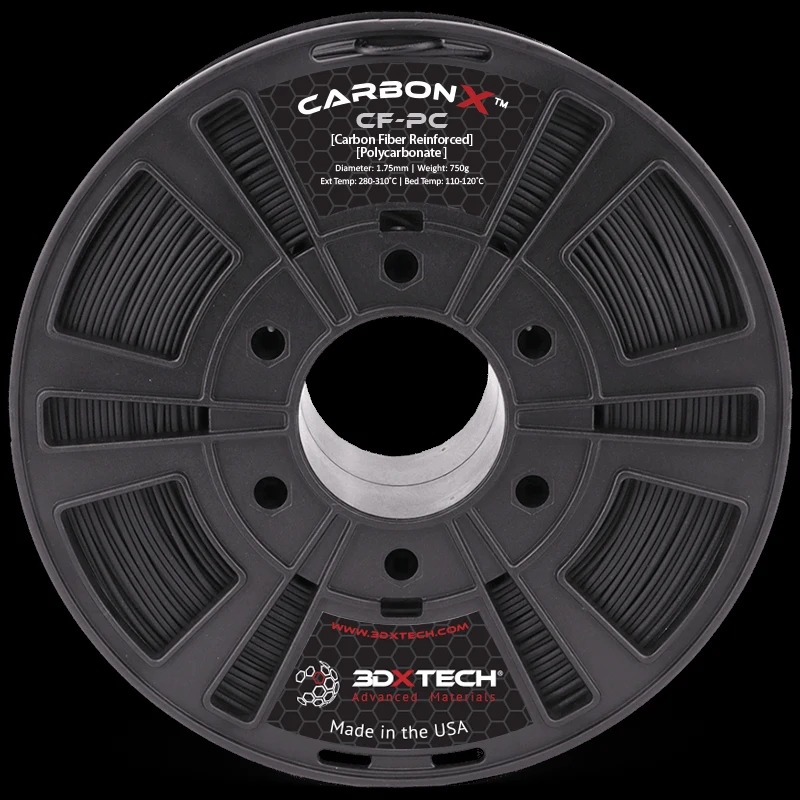
A USA-made carbon-fiber reinforced polycarbonate — engineered for structural end-use parts that demand high heat resistance, high stiffness, excellent surface quality, and near-isotropic dimensional stability. Chopped carbon fiber boosts modulus and holds dimensions; polycarbonate’s amorphous matrix keeps shrinkage low. Compounded in Grand Rapids, Michigan. Full specifications →
Made in the USA — ships from Rev1. Need a print profile, a 2 kg production reel, or bulk pricing? Call (248) 707-2950.
USA-made carbon-fiber polycarbonate, with a real datasheet behind it.
3DXTech compounds CarbonX PC+CF in Grand Rapids, Michigan at its 68,000 sq ft facility, with an ISO-tested technical data sheet — density, tensile, flexural, and thermal figures you can design to. Rev1 Technologies is your authorized 3DXTech reseller and US support partner, Auburn Hills, Michigan.

Polycarbonate’s heat and toughness, stiffened with carbon fiber.
CarbonX PC+CF takes one of the most demanding engineering thermoplastics — polycarbonate — and reinforces it with chopped carbon fiber. The result is a filament for structural components that need high heat resistance, high stiffness, excellent surface quality, and dimensional stability, all in a single material you can run on a capable FFF printer. Because polycarbonate is amorphous, it shrinks very little and stays near-isotropic, so complex geometries hold their dimensions instead of warping or twisting as they cool. 3DXTech compounds it in the USA into consistent, printable filament for end-use parts, brackets, ducts, and fixtures.
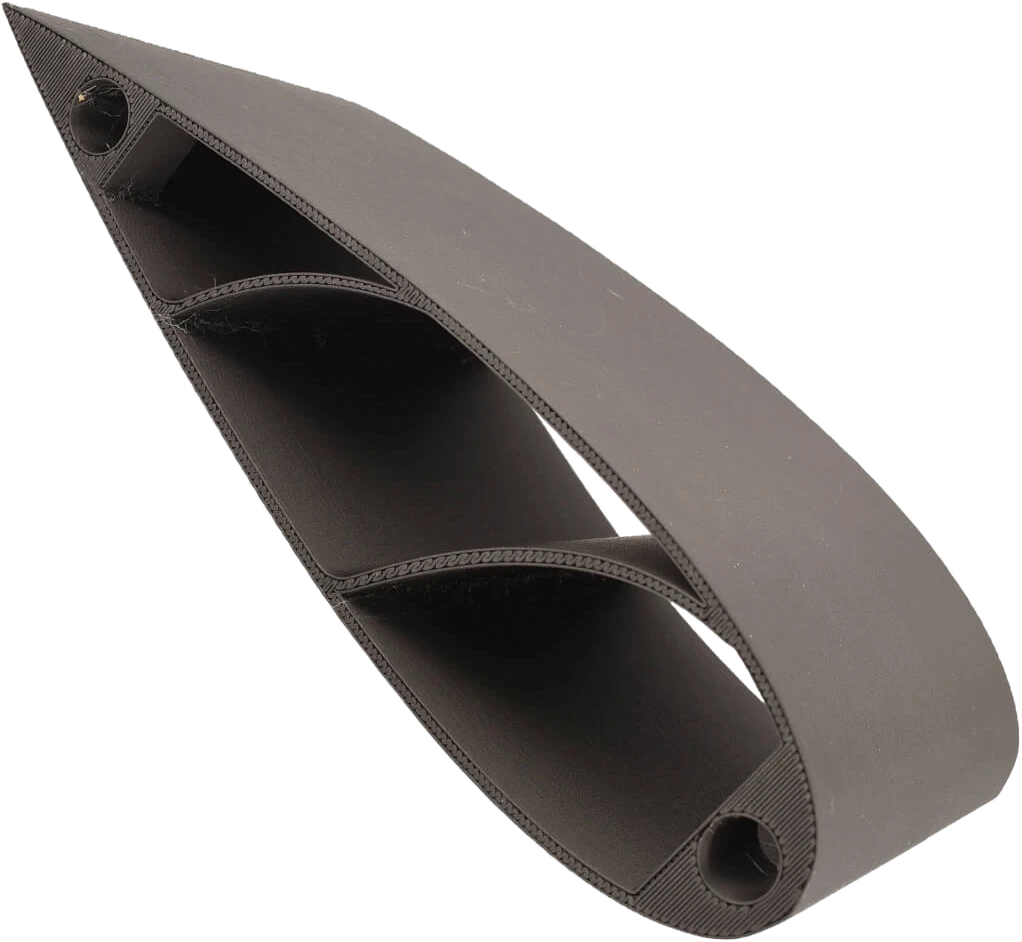
Print stiff, dimensionally stable end-use parts.
Carbon fiber adds stiffness and holds dimensions; polycarbonate brings the heat resistance and surface finish.
The chopped-carbon reinforcement raises the tensile modulus to roughly 6,200 MPa and improves dimensional stability, so printed brackets, ducts, housings, and fixtures resist deflection under load. The amorphous PC matrix minimizes shrinkage for near-isotropic mechanical behavior even on geometrically complex parts — and it prints with a notably low odor.
The numbers, straight from the ISO-tested TDS.
All values are 3DXTech-published typical figures from the CarbonX CF-PC technical data sheet (ISO 527 tensile, ISO 178 flexural, ISO 1183 density) — see the full TDS for test methods and specimen conditions.
Tensile strength at break per ISO 527 — strong enough for load-bearing structural parts.
High stiffness from the chopped carbon fiber (ISO 527) — parts resist bending and deflection.
Flexural strength per ISO 178 — rigid, stable geometry under bending load.
High flexural modulus per ISO 178 keeps large, flat features from bowing.
Measured per ISO 1183 — a lightweight, stiff structural polymer for weight-sensitive parts.
Low elongation (ISO 527) reflects a stiff, rigid material rather than a flexible one.
A wide processing window — and a hardened nozzle.
These are 3DXTech’s recommended print settings. CarbonX PC+CF prints across a generous 280–310°C range on a heated bed; carbon fiber is abrasive, so a hardened steel nozzle is a must, and polycarbonate is hygroscopic, so dry it first.
A wide processing window; the TDS test specimens were printed at 300°C on an all-metal hotend.
A high-temperature heated bed with a suitable adhesive gives strong first-layer grip and reduces warp.
An enclosed or actively heated chamber improves layer bonding and dimensional stability on big parts.
Chopped carbon fiber is abrasive — use a hardened-steel nozzle rather than brass, which wears fast.
Run 0.25 mm or thicker layers (per TDS specimen conditions) for consistent flow with the filled filament.
Polycarbonate absorbs moisture; dry at 120°C for 4 hours and keep it dry for the best surface and strength.
Built for heat-tolerant, structural, end-use parts.
From CAD to a heat-tolerant, load-bearing part that ships.
Print functional brackets, ducts, housings, and end-use components.
Because it’s stiff, heat-resistant, and dimensionally stable, CarbonX PC+CF is a go-to for parts that actually go into service — not just prototypes. High modulus with a 143°C glass transition lets parts hold shape and load where nylon or PETG would soften, which is why it lands in aerospace, automotive, and industrial tooling.
Check the reel fits your printer.
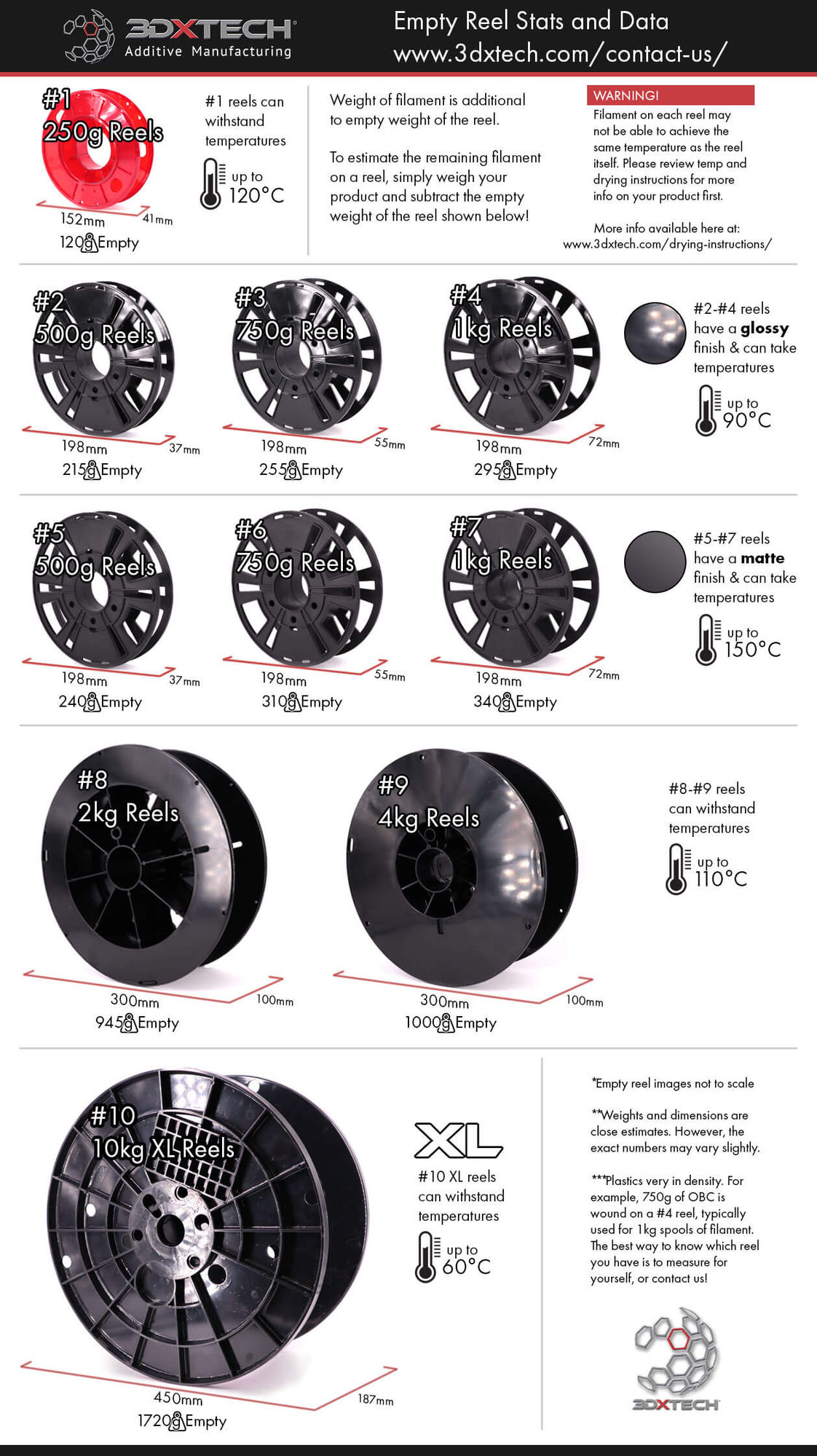
Standard spool dimensions — confirm it fits your AMS or dry box.
3DXTech ships CarbonX PC+CF on consistent, standard reels.
Before you buy, check the outer diameter, width, and center bore against your printer’s spool holder, automated material system, or drybox. The 750 g spool is sized to fit popular systems like Bambu AMS, Creality CFS, and Anycubic ACE Pro. Open the full 3DXTech reel infographic for the exact dimensions of the 750 g and 2 kg spools.
View reel dimensions →PC+CF vs. other carbon-fiber engineering filaments.
Approximate positioning among printable carbon-fiber-reinforced engineering polymers; confirm exact figures against each technical data sheet.
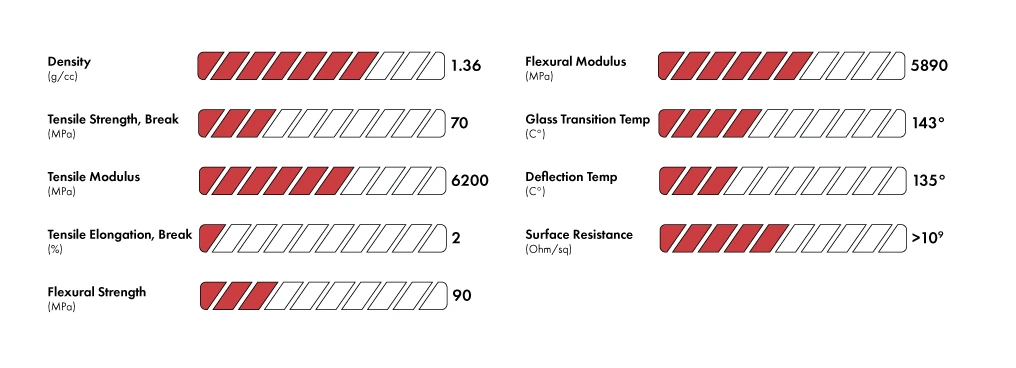
143°C glass transition, 135°C heat-deflection.
Thermal figures from the TDS (DSC for Tg, ISO 75 for deflection temperature at 0.45 MPa).
A glass transition temperature (Tg) of 143°C and a heat-deflection temperature of 135°C at 0.45 MPa put CarbonX PC+CF among the highest-temperature materials you can run on a capable FFF printer — ideal for under-hood, near-motor, and other elevated-temperature environments. Open the property chart for the full mechanical and thermal profile at a glance.
| CarbonX PC+CF | PA6+CF (Nylon) | PEI/ULTEM+CF | |
|---|---|---|---|
| Glass transition (Tg) | ~143°C | ~60°C (dry) | ~215°C |
| Tensile modulus | ~6,200 MPa | ~4,000–7,000 MPa | ~5,000–8,000 MPa |
| Moisture sensitivity | Moderate | High | Low |
| Print difficulty | Moderate (hardened nozzle) | Moderate–high | High (chamber) |
| Best for | Heat + stiffness + surface finish | Toughness + wear | Max temp + FST rating |
Qualitative comparison among printable carbon-fiber engineering polymers; confirm exact properties against each TDS. Prices vary by reel size and date.
3DXTech CarbonX PC+CF Technical Data
RESOURCES
Datasheets & Print Support
Everything you need to qualify, slice, and print CarbonX PC+CF with confidence.
WHY REV1 TECH
Authorized 3DXTech Reseller. Engineering-Materials Specialists.
Rev1 Technologies is an authorized 3DXTech reseller in Auburn Hills, MI, supplying genuine USA-made engineering filament with real print support.
We help you pick the right engineering polymer, dial in the profile, and keep production running.
FAQ
3DXTech CarbonX PC+CF — Common Questions
What printer do I need for CarbonX PC+CF?
A capable FFF printer with an all-metal hotend that reaches 280–310°C, a heated bed at 110–120°C, and ideally an enclosed or actively heated chamber for large parts. Because the carbon fiber is abrasive, you must use a hardened steel nozzle (0.4 mm minimum) — brass wears out quickly.
Do I have to dry it before printing?
Yes. Polycarbonate absorbs moisture, which causes poor surface finish and weak layers. 3DXTech recommends drying at 120°C for 4 hours before printing, then keeping the spool in a dry box during long jobs.
How strong and stiff is it?
Per the 3DXTech TDS, tensile strength is 70 MPa with a tensile modulus of 6,200 MPa and flexural strength of 90 MPa (flexural modulus 5,890 MPa). The carbon fiber makes it noticeably stiffer than unfilled polycarbonate.
How much heat can printed parts take?
CarbonX PC+CF has a glass transition (Tg) of 143°C and a heat-deflection temperature of 135°C at 0.45 MPa — among the highest available in FFF 3D printing, well beyond PLA, PETG, or ABS.
Which reel size should I buy?
Start with the 750 g spool to validate your profile and part — it fits automated systems like Bambu AMS, Creality CFS, and Anycubic ACE Pro. The 2 kg production reel is a special-order minimum-order-quantity item; contact Rev1 for lead time and pricing.
How does PC+CF compare to nylon+CF?
PC+CF has a much higher glass transition (~143°C vs ~60°C dry for PA6) and excellent surface finish and dimensional stability, while nylon+CF grades trade some heat resistance for toughness and wear resistance. If your part needs heat and stiffness with a clean finish, PC+CF is usually the better fit — we can help you decide.
One of the highest heat resistances available in 3D printing.
Polycarbonate’s inherently high glass transition gives CarbonX PC+CF real thermal headroom — parts hold their shape and stiffness where PLA, PETG, and ABS have long since softened.