3DXSTAT ESD-TPU • 3DXTECH • REV1 TECH
3DXTech 3DXSTAT™ ESD-TPU (90A) Flexible ESD Filament — 10^2–10^3 Ω/sq · Shore 90A · >300% Elongation
Flexible ESD Filament — 102–103 Ω/sq · Shore 90A · >300% Elongation
The only ESD-safe flexible filament available. 3DXSTAT™ ESD-TPU delivers 10²–10³ Ω/sq surface resistance — the most conductive option in the entire 3DXSTAT line — in a Shore 90A semi-flexible thermoplastic polyurethane. Print ESD-safe gaskets, grip covers, seals, and flex-fit covers that no rigid ESD material can replace. Made in Grand Rapids, Michigan.
750g in stock. Contact Rev1 to confirm availability.
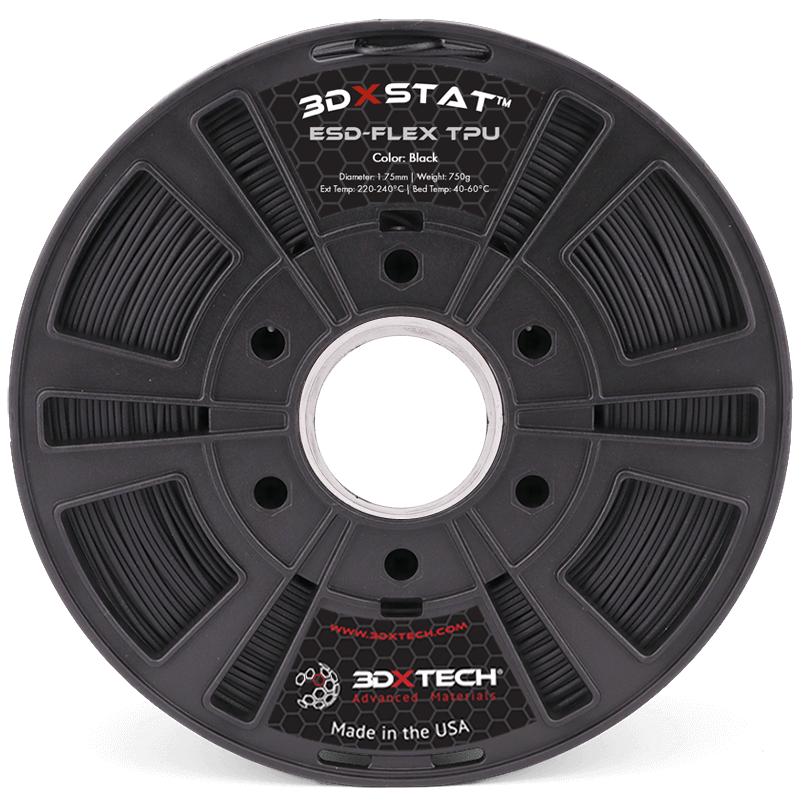
WHY 3DXSTAT ESD-TPU
The Only ESD-Safe Flexible Filament. 102–103 Ω/sq. Shore 90A.
3DXSTAT™ ESD-TPU is 3DXTech’s most conductive ESD material — and the only one that flexes. Shore 90A thermoplastic polyurethane base delivers >300% elongation at yield, meaning parts deform and recover rather than cracking under impact or deflection. No rigid ESD filament can produce a compliant gasket, a grip cover, or a flex-fit seal. ESD-TPU occupies a unique niche in the 3DXSTAT line and in the entire FFF ESD materials market.
Most Conductive ESD in the Line — 102–103 Ω/sq
Surface resistance of 10²–10³ Ω/sq — two to six orders of magnitude more conductive than ESD-PETG, ESD-ABS, or ESD-PC grades. Provides the strongest possible ESD charge path while remaining in the dissipative-to-conductive range per ASTM D257.
Only ESD-Safe Flexible Filament
Standard TPU prints flexible but has no ESD protection. All other ESD filaments are rigid. 3DXSTAT ESD-TPU is the only material that combines ESD dissipation with Shore 90A semi-flexible behavior — enabling form factors impossible in rigid ESD materials.
>300% Elongation at Yield
Parts stretch, compress, and recover without cracking or shattering. Ideal for gaskets, grommets, snap covers, and bump protectors that experience mechanical deformation in use. Rigid ESD materials would fracture under the same loading conditions.
Made in USA — ISO 9001
Extruded and wound at 3DXTech’s Grand Rapids, MI facility under ISO 9001:2015 certification. Consistent ESD additive loading for repeatable surface resistance across lots. Black color — standard for ESD-identified components.
PRINTING WITH 3DXSTAT ESD-TPU
ESD-TPU — Flexible Filament, Standard Platform Compatible
3DXSTAT ESD-TPU prints at 220–240°C on a 40–60°C bed — no enclosure required. Print slowly (20–30 mm/s) to avoid stringing and maintain dimensional accuracy. Standard brass nozzle compatible. Dry before every session.
- Extruder Temp 220–240°C — standard all-metal or PTFE-lined hot end compatible at this range
- Bed Temp 40–60°C — PEI or glass build surface; TPU adheres well without aggressive bed temperatures
- Chamber Temp Not required — TPU prints well at ambient temperature; enclosure is not needed for warping control
- Print Speed 20–30 mm/s recommended — slow speeds are critical for flexible filaments to prevent stringing and maintain bead geometry
- Nozzle Standard brass ≥0.4mm — ESD additive is not abrasive; hardened nozzle not required
- Drying 65°C / 4 hr minimum before every print session — TPU absorbs moisture and wet filament causes stringing
- ⚠ Retraction Warning Flexible filaments are sensitive to retraction. Use minimal retraction (0.5–1.5 mm) or disable retraction entirely if stringing persists. Excessive retraction causes the soft filament to compress and buckle in the Bowden tube or drive gear.
FLEXIBILITY DATA
Shore 90A — Semi-Flexible Performance for ESD Applications
Four mechanical milestones defining 3DXSTAT™ ESD-TPU’s flexibility envelope — verified against 3DXTech 3DXSTAT ESD-TPU product data.
Semi-flexible — firm but compliant, like a stiff rubber band or dense gasket material. Can be deformed and returns to shape. Harder than soft TPUs (Shore 85A) but far more flexible than any rigid engineering polymer.
Parts stretch to more than three times their original length before yielding. No other ESD filament approaches this level of deformability. Critical for applications requiring snap-fit installation or sustained mechanical deflection.
Lower than rigid ESD grades by design — TPU trades tensile strength for elongation and impact energy absorption. Appropriate for gaskets, covers, and grips where compliance is the functional requirement, not structural load-bearing.
Low abrasion loss = high wear resistance. 3DXSTAT ESD-TPU outperforms rigid ESD materials in abrasion-resistance applications — important for ESD roller covers, cable management clips, and anti-static contact surfaces.
ESD PROPERTIES
102–103 Ω/sq — Most Conductive ESD Option in the 3DXSTAT Line
3DXSTAT™ ESD-TPU delivers surface resistance of 10²–10³ Ω/sq per ASTM D257 — two to six orders of magnitude more conductive than ESD-PETG, ESD-ABS, or ESD-PC grades (which typically measure 10⁷–10⁹ Ω/sq). The flexible base material enables ESD-safe form factors that rigid materials cannot achieve: compliant gaskets, seals, and bump covers that carry charge to ground.
Surface resistance per ASTM D257. Test printed parts after manufacturing — anisotropic FFF microstructure can affect measured resistance. Not suitable for applications requiring electrical insulation or high mechanical structural loading.
SPECIFICATIONS
3DXSTAT™ ESD-TPU — Full Technical Data
Source: 3DXTech 3DXSTAT ESD-TPU product data. ISO-standard test specimens. 1.75mm black filament. Flexible material — no tensile modulus or flexural modulus values apply to Shore 90A TPU.
Material Properties
| Polymer | Thermoplastic Polyurethane (TPU) + ESD additives |
| Diameter | 1.75mm |
| Color | Black |
| Shore Hardness | 90A (ISO 868) — semi-flexible |
| Tensile Strength at Yield | 12 MPa (ISO 527) |
| Elongation at Yield | >300% (ISO 527) |
| Flexural Strength | 31 MPa (ISO 178) |
| Abrasion Loss | 25 mm³ (ISO 4649-A) |
| Density | 1.18 g/cc |
| Surface Resistance | 10²–10³ Ω/sq (most conductive ESD in line) |
| ESD Standard | ASTM D257 |
Print Parameters
| Extruder Temp | 220–240°C |
| Bed Temp | 40–60°C |
| Chamber Temp | Not required |
| Print Speed | 20–30 mm/s (slow for flexibility) |
| Drying Protocol | 65°C / 4 hr minimum |
| Nozzle | Standard brass ≥0.4mm |
| Retraction | Minimal (0.5–1.5 mm) or disabled |
Availability
| Spool Sizes (Available) | 750g (in stock) |
| 750g Price | $135 |
| Lead Time | Varies — contact Rev1 to confirm |
| Quality Standard | ISO 9001:2015 Certified |
| Origin | Grand Rapids, MI, USA |
| SKU | 3DXT-STAT-ESDTPU-175-750 |
SPOOL SELECTION
750g Available. Black. 1.75mm.
3DXSTAT™ ESD-TPU is available in a single spool size: 750g Black (1.75mm). Consistent ESD additive loading ensures repeatable surface resistance across the spool.
- 1.75mm diameter — Black
- Shore 90A semi-flexible
- Ships from stock
PRINT QUALITY
Flexible ESD Parts — Form Factors Impossible in Rigid Materials
3DXSTAT™ ESD-TPU produces compliant, ESD-safe parts in geometries no rigid filament can achieve. Shore 90A semi-flexibility enables gaskets, grips, and covers that deform in use and return to shape.
COMPATIBLE PLATFORMS
Prints on Most Platforms — 220–240°C, No Enclosure Required
3DXSTAT ESD-TPU’s 220–240°C extrusion range is within reach of virtually any desktop or industrial FFF printer. No heated enclosure required. Standard brass nozzle compatible. Direct-drive extruders handle flexible filaments better than Bowden setups.
CreatBot F160-PEEK
Industrial platform with dual all-metal hot ends and direct-drive feed. Validated for high-performance materials including flexible TPU grades. Rev1’s recommended platform for demanding ESD filament applications.
Rev1 RecommendedCreatBot F430
Quad-nozzle large-format industrial printer. Supports ESD-TPU plus support materials for complex flex geometries. Multi-material capability enables rigid support structures with flexible ESD part bodies.
Rev1 RecommendedDirect-Drive Desktop Printers
Bambu Lab, Prusa MK4, Ultimaker S-series, and similar direct-drive platforms handle flexible filaments well. Bowden extruder setups are possible but require careful retraction tuning. 220–240°C is within standard hot end ratings.
Any Open-Platform Printer
Minimum: 240°C hot end • 60°C heated bed • standard brass nozzle ≥0.4mm • slow print speed (20–30 mm/s) • minimal retraction.
WHERE IT WORKS
ESD-Safe Applications That Require a Flexible Material
Every application below requires both ESD protection and physical compliance. No rigid ESD filament — not ESD-PC, not ESD-PETG, not ESD-ABS — can deliver both. 3DXSTAT ESD-TPU is the only material that fills this gap.
ESD-Safe Gaskets & Seals
Static-dissipative gaskets for electronics enclosures, EMI shields, and PCB housings where charge must be controlled across a compliant seal interface. Shore 90A compresses to form a seal and recovers when released.
Grip Covers & Tool Handles
ESD-safe grip covers for semiconductor handling tools, PCB probes, and assembly fixtures. Shore 90A provides tactile feedback and vibration damping while maintaining 10²–10³ Ω/sq surface resistance throughout the grip surface.
Flex-Fit Component Covers
Snap-on ESD covers for sensitive components, connectors, and ports that require physical protection during handling. Flexible covers install and remove repeatedly without the cracking risk of rigid ESD covers under snap-fit stress.
Bump Protection Pads
Anti-static bump pads and corner protectors for PCBs, displays, and electronics during transit and assembly. TPU absorbs impact energy while maintaining ESD dissipation — rigid ESD materials shatter under the same impact loads.
Anti-Static Roller Covers
Replacement covers for conveyor rollers, press rollers, and material handling equipment in ESD-controlled environments. 25 mm³ abrasion loss demonstrates excellent wear resistance for sustained rolling contact applications.
Cable Management & Grommets
ESD-safe cable clips, grommets, and strain reliefs for electronics assembly stations and clean rooms. Flexible body allows installation around existing cables without disconnection. Static-dissipative surface prevents charge accumulation on cable bundles.
MATERIAL CARE
Dry Before Every Session. Print Slowly. Minimize Retraction.
3DXSTAT ESD-TPU is a flexible filament — follow TPU best practices for storage and printing. Moisture causes stringing and surface defects. Print speed and retraction have outsized effects on part quality in flexible materials.
Dry Before Every Session
65°C minimum / 4 hours minimum. TPU absorbs moisture — wet filament produces stringing, rough surface texture, and reduced ESD performance consistency.
Slow Print Speed
Print at 20–30 mm/s. Flexible filaments buckle in the feed path at high speeds. Slow, consistent extrusion produces clean beads with accurate Shore 90A wall thickness.
Minimize or Disable Retraction
Use 0.5–1.5 mm retraction or disable entirely. Excessive retraction compresses the flexible filament in the drive path and causes jamming. Stringing from minimal retraction is easier to manage than drive-path jams.
Store Sealed With Desiccant
Return unused filament to an airtight bag or container with fresh desiccant immediately after printing. Long-term storage in original sealed packaging is acceptable.
HOW IT COMPARES
3DXSTAT™ ESD-TPU vs. Commonly Evaluated Alternatives
Buyers evaluating 3DXSTAT ESD-TPU typically compare against 3DXSTAT ESD-PC (rigid ESD alternative in the same line), standard non-ESD TPU (flexible but no ESD protection), and Stratasys Antero 800NA ESD (rigid, high-cost, platform-locked).
3DXTech / Rev1 Tech
3DXTech
Generic / Various
Stratasys
3DXTECH QUALITY
Manufactured in Michigan. Certified to ISO 9001:2015.
Every spool of 3DXSTAT™ ESD-TPU is produced in-house at 3DXTech’s Grand Rapids, MI facility under ISO 9001:2015 certification. ESD additive compounded with TPU resin for consistent lot-to-lot surface resistance, with full lot traceability throughout filament fabrication.
ISO 9001:2015 Certified
Production under a certified quality management system. Lot traceability and process controls throughout flexible filament fabrication.
Made in Grand Rapids, MI
Filament extruded and wound in-house at 3DXTech’s Michigan facility. Direct factory quality control — not overseas commodity production.
Technical Data Available
Full processing parameters, mechanical properties, Shore hardness data, and ESD surface resistance measurement methodology published in 3DXTech’s 3DXSTAT ESD-TPU product documentation. Available via the link below.
RESOURCES
Downloads & Technical Support
Everything you need to qualify and print 3DXSTAT™ ESD-TPU with confidence. ESD resistance data, processing parameters, and technical support from Rev1.
WHY REV1 TECH
Authorized 3DXTech Reseller. Industrial AM Specialists.
Rev1 Technologies is an authorized 3DXTech reseller headquartered in Auburn Hills, MI, with direct technical expertise in high-performance FFF materials and the printers that run them.
Authorized Reseller
Every spool ships direct from the authorized channel. MAP pricing guaranteed. Single-channel license compliance — not a grey-market distributor.
Platform Expertise
If you need guidance on which platform to match with 3DXSTAT ESD-TPU — or whether a flexible vs. rigid ESD material is the right choice for your application — our team has run them.
Pre-Sales Technical Support
Questions about print settings, flexible filament setup, or qualifying ESD-TPU for electronics manufacturing applications? Contact Rev1 before you order — that conversation is free.
FREQUENTLY ASKED
3DXSTAT™ ESD-TPU — Buyer & Engineer Questions Answered
What is 3DXSTAT™ ESD-TPU?
3DXSTAT™ ESD-TPU is 3DXTech’s electrostatic dissipative thermoplastic polyurethane filament. It is the only ESD-safe flexible filament available — combining Shore 90A semi-flexible TPU with ESD surface resistance of 10²–10³ Ω/sq per ASTM D257. Available in Black (1.75mm, 750g) at $135. The most conductive material in the entire 3DXSTAT ESD line.
What does Shore 90A mean, and is it flexible enough to replace a gasket?
Shore 90A is a semi-flexible durometer — comparable to a stiff rubber band or a dense gasket material. It will deform under moderate hand force and return to its original shape. For static-dissipative gaskets that compress to seal and recover when the enclosure is opened, Shore 90A is appropriate. It is firmer than soft TPU grades (Shore 85A) but far more compliant than any rigid ESD material. For applications requiring very soft compliance (like a foam-replacement seal), contact Rev1 to discuss the application.
Why is 3DXSTAT ESD-TPU more conductive than other ESD filaments?
3DXSTAT ESD-TPU delivers 10²–10³ Ω/sq surface resistance — the conductive end of the ESD spectrum per ASTM D257, versus the dissipative range (10⁷–10⁹ Ω/sq) typical of ESD-PC, ESD-ABS, and ESD-PETG grades. The higher conductivity means faster charge dissipation to ground. This is the most effective ESD protection available in the 3DXSTAT line. Use this when rapid charge bleed is required; use ESD-PC or ESD-PETG when a slower dissipative path is preferred.
Can I use standard TPU instead of ESD-TPU for my application?
Standard TPU has no ESD protection. Surface resistance of standard TPU is typically insulative (>10¹² Ω/sq) — it will accumulate static charge. If your application involves contact with ESD-sensitive components (microelectronics, PCBs, MEMS), standard TPU creates a risk of electrostatic discharge events. 3DXSTAT ESD-TPU delivers the same Shore 90A flexibility with 10²–10³ Ω/sq surface resistance, providing a positive charge dissipation path.
What applications use 3DXSTAT™ ESD-TPU?
3DXSTAT ESD-TPU is used for static-dissipative gaskets and seals for electronics enclosures, ESD-safe grip covers and tool handles for semiconductor handling equipment, flex-fit snap covers for sensitive connectors and components, bump protection pads for PCBs during transit, anti-static roller covers for conveyor equipment, and ESD-safe grommets and cable management clips for electronics assembly stations.
Does 3DXSTAT ESD-TPU require special printing equipment?
No. 3DXSTAT ESD-TPU prints at 220–240°C on a 40–60°C bed — within reach of most desktop and industrial FFF printers. No heated enclosure is required. Standard brass nozzle ≥0.4mm is compatible. A direct-drive extruder handles flexible filaments better than Bowden setups, but Bowden is possible with careful tuning. Print slowly (20–30 mm/s) and use minimal retraction.
How does 3DXSTAT ESD-TPU compare to Stratasys Antero 800NA ESD?
Stratasys Antero 800NA ESD is a rigid PEKK-based material — no flexibility, platform-locked to Stratasys printers, and significantly higher cost. 3DXSTAT ESD-TPU is flexible (Shore 90A vs. fully rigid), open-material platform compatible, and substantially lower cost at $135/750g. For applications where high-temperature PEKK performance is needed, Antero may be appropriate. For applications requiring flexibility or compliance — gaskets, grip covers, snap-fit covers — ESD-TPU is the only viable option.
What spool sizes are available and what is in stock?
3DXSTAT™ ESD-TPU is available in one spool size: 750g Black ($135), which ships from stock. All filament is 1.75mm diameter, Shore 90A. No other spool sizes are standard for this SKU. SKU: 3DXT-STAT-ESDTPU-175-750.