3DXSTAT ESD-PETG • 3DXTECH • REV1 TECH
3DXTech 3DXSTAT™ ESD-PETG ESD-Safe PETG for Electronics Manufacturing
ESD-Safe PETG — 107–109 Ω/sq · No Chamber Required · Made in USA
3DXTech’s 3DXSTAT ESD-PETG delivers reliable ESD dissipation at 107–109 Ω/sq using carbon nanotube (CNT) technology — meeting ANSI/ESD S4.1 requirements without abrasive fillers. PETG base resin provides 13% elongation at break and an 80°C glass transition temperature. No heated chamber required — lower barrier to entry than ESD-PC for electronics tray and fixture production. Made in Grand Rapids, Michigan.
750g in stock. Contact Rev1 to confirm availability.
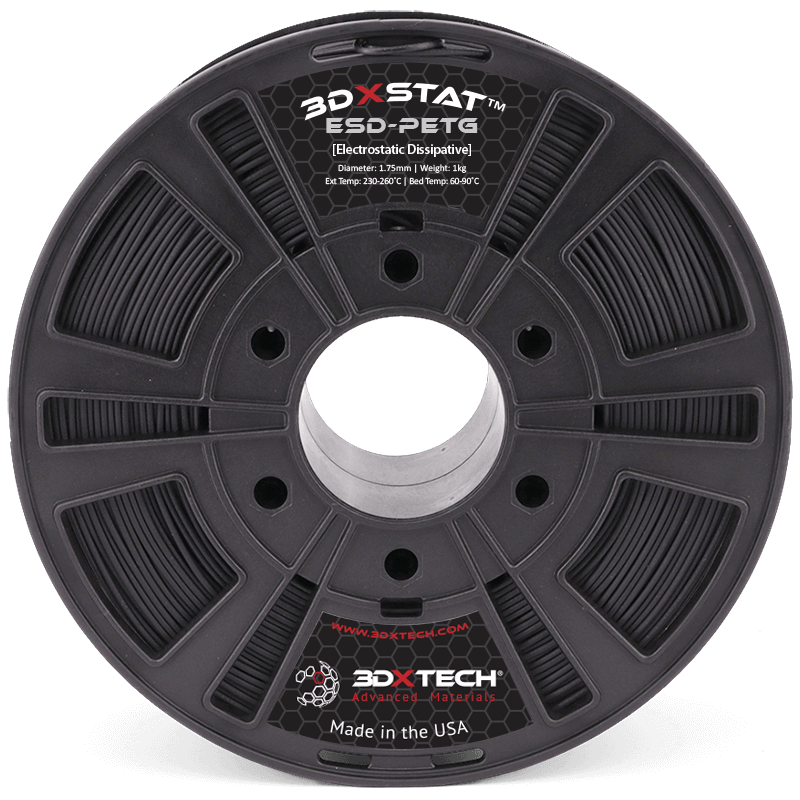
WHY 3DXSTAT ESD-PETG
107–109 Ω/sq ESD Dissipation. PETG Ductility. No Chamber Required.
3DXSTAT™ ESD-PETG is 3DXTech’s carbon nanotube ESD PETG filament — engineered to meet ANSI/ESD S4.1 surface resistance requirements (107–109 Ω/sq) while preserving PETG’s snap-fit-friendly ductility (13% elongation) and chemical resistance. CNT additive delivers consistent, uniform ESD dissipation without abrasive fillers. No heated chamber required — prints on a broader range of desktop and benchtop platforms. 80°C glass transition temperature. Natural color black — standard for ESD-identified components.
107–109 Ω/sq ESD Dissipation
Carbon nanotube ESD additive delivers surface resistance of 107–109 Ω/sq — the ANSI/ESD S4.1 dissipative range. Protects ESD-sensitive components from charge buildup and discharge events during handling, assembly, and storage.
No Chamber Required — Lower Printer Barrier
PETG prints without a heated enclosure — unlike ESD-PC. Compatible with a wide range of desktop and benchtop FFF printers. A standard brass nozzle ≥0.4mm is required; hardened steel recommended due to CNT additive wear.
13% Elongation — Ductile & Snap-Fit Friendly
PETG base resin delivers 13% elongation at break — significantly more ductile than CF-reinforced ESD grades. Snap-fit clips, living hinges, and flexible tray geometries are viable without brittle fracture risk.
Made in USA
Extruded and wound in-house at 3DXTech’s Grand Rapids, MI facility under ISO 9001:2015 certification. Consistent CNT loading for repeatable ESD performance across lots. Black color — standard identification for ESD components.
PRINTING WITH 3DXSTAT ESD-PETG
ESD-PETG — CNT PETG, No Chamber, Broad Platform Compatibility
3DXSTAT ESD-PETG prints similarly to standard PETG — 230–260°C extrusion with a heated bed at 60–90°C. No heated chamber required. Hardened nozzle recommended due to CNT additive. Dry at 65°C before every session to prevent moisture-induced splay.
- Extruder Temp 230–260°C — all-metal hot end required; standard PTFE-lined hot ends are compatible at the lower end of range
- Bed Temp 60–90°C — PEI, glass, or garolite build surface preferred; PETG adheres well and releases cleanly when cooled
- Chamber Temp Not required — PETG does not warp significantly at ambient temperature; open-frame printers are suitable
- Nozzle Hardened steel ≥0.4mm recommended — CNT additive causes gradual brass nozzle wear; standard brass acceptable for low-volume use
- Drying 65°C / 4 hr minimum before every print session
- ⚠ Moisture Warning PETG is hygroscopic. Wet filament causes splay, stringing, and weak layer adhesion — signs are audible popping during extrusion and increased stringing. Dry at 65°C / 4 hr before every session and print from a sealed dry-box for best results.
THERMAL DATA
80°C Tg — PETG Thermal Performance for ESD Electronics Fixtures
Four thermal milestones defining 3DXSTAT™ ESD-PETG’s operating envelope — verified against 3DXTech 3DXSTAT ESD-PETG product data.
Glass transition temperature of the PETG matrix. ESD tooling, trays, and fixtures can be used in environments up to ~65°C continuous service under load. Suitable for room-temperature and low-heat electronics assembly environments.
HDT at 0.45 MPa. Parts maintain structural integrity under moderate load up to 75°C — suitable for ESD trays in ambient-temperature PCB handling, inspection, and packaging workflows. Not suitable for reflow oven environments.
Estimated continuous-use service temperature for load-bearing applications. Suitable for ambient-temperature electronics assembly environments. For higher temperatures (reflow, wave solder), consider 3DXSTAT ESD-PC instead.
Required before every session. PETG is hygroscopic — moisture causes splay, stringing, and reduced mechanical properties. Drying at 65°C for 4 hours is sufficient for most use cases.
ESD PROPERTIES
107–109 Ω/sq — ANSI/ESD S4.1 Dissipative Range
3DXSTAT™ ESD-PETG delivers surface resistance in the ANSI/ESD S4.1 electrostatic dissipative range (107–109 Ω/sq). CNT additive provides consistent, uniform ESD dissipation across the part surface — unlike carbon fiber which creates directional conductivity. Protective of ESD-sensitive components (microelectronics, PCBs, MEMS devices) during handling, assembly, packaging, and transport. PETG’s chemical resistance to common cleaning agents makes it well-suited for ESD fixtures in electronics production environments.
Surface resistance per ASTM D257. Test printed parts after manufacturing — anisotropic FFF microstructure can affect measured resistance. Not suitable for applications requiring electrical insulation or high-temperature service above 75°C HDT.
SPECIFICATIONS
3DXSTAT™ ESD-PETG — Full Technical Data
Source: 3DXTech 3DXSTAT ESD-PETG product data. ISO-standard test specimens. 1.75mm black filament.
Material Properties
| Polymer | PETG (glycol-modified PET) + CNT ESD |
| Diameter | 1.75mm |
| Color | Black |
| Glass Transition (Tg) | 80°C |
| HDT (0.45 MPa, ISO 75) | 75°C |
| Continuous Use Temp | ~65°C |
| Surface Resistance | 107–109 Ω/sq (ESD dissipative) |
| ESD Standard | ANSI/ESD S4.1 dissipative range |
| Tensile Strength | 50 MPa (ISO 527) |
| Tensile Modulus | 1,800 MPa (ISO 527) |
| Flexural Strength | 74 MPa (ISO 178) |
| Flexural Modulus | 1,780 MPa (ISO 178) |
| Elongation at Break | 13% (ISO 527) |
| Density | 1.28 g/cm³ (ISO 1183) |
Print Parameters
| Extruder Temp | 230–260°C |
| Bed Temp | 60–90°C |
| Chamber Temp | Not required |
| Drying Protocol | 65°C / 4 hr minimum |
| Nozzle | Hardened steel ≥0.4mm recommended |
| Hot End Requirement | All-metal recommended (230–260°C) |
Availability
| Spool Sizes (Available) | 750g (in stock) |
| 750g Price | $105 |
| Lead Time | Varies — contact Rev1 to confirm |
| Quality Standard | ISO 9001:2015 Certified |
| Origin | Grand Rapids, MI, USA |
SPOOL SELECTION
750g Available. Black. 1.75mm.
3DXSTAT™ ESD-PETG is available in a single spool size: 750g Black (1.75mm). Consistent CNT loading ensures repeatable ESD performance across the spool.
- 1.75mm diameter — Black
- CNT ESD additive — uniform loading
- Ships from stock
PRINT QUALITY
Clean ESD-Safe Output on Accessible Platforms
3DXSTAT™ ESD-PETG produces parts with consistent ESD dissipation across the printed surface. PETG’s lower print temperature and no-chamber requirement broadens compatible platforms. Black color is standard for ESD-identified components in electronics manufacturing environments.
COMPATIBLE PLATFORMS
Broad Platform Compatibility — No Chamber Required
3DXSTAT ESD-PETG prints at 230–260°C — compatible with a wide range of desktop and industrial FFF platforms. No heated enclosure required. Hardened nozzle recommended due to CNT wear on brass.
CreatBot F160-PEEK
Purpose-built high-performance platform with dual all-metal hot ends and integrated chamber heating. Validated for demanding materials — more than needed for ESD-PETG but delivers maximum process consistency.
Rev1 RecommendedCreatBot F430
Quad-nozzle large-format industrial printer with multi-material capability. Supports ESD-PETG plus support materials for complex geometries and dual-extrusion workflows.
Rev1 RecommendedBambu Lab X1C / P1S
High-speed enclosed desktop platform capable of 260°C extrusion and 90°C bed. Suitable for ESD-PETG production workflows at affordable price points. Hardened nozzle required.
Any Open-Platform Printer
Minimum: 260°C hot end • 90°C heated bed • No chamber required • Hardened steel nozzle ≥0.4mm recommended.
WHERE IT WORKS
Where ESD-PETG Outperforms Standard PETG — Without the PC Complexity
When you need ESD protection in a ductile, snap-fit-friendly material that prints on any open-frame printer — 3DXSTAT ESD-PETG delivers. Lower barrier to entry than ESD-PC with PETG’s excellent chemical resistance to IPA, mild solvents, and cleaning agents common in electronics assembly.
ESD Trays & Carriers
Custom ESD trays, pallets, and carriers for PCB and electronic component handling in ambient-temperature assembly, inspection, and packaging workflows. PETG’s ductility enables snap-fit and flexure features that brittle CF-filled ESD grades cannot.
Electronics Assembly Fixtures
PCB assembly jigs, test fixtures, and pick-and-place tooling where charge buildup during automated assembly could damage ESD-sensitive components. CNT ensures consistent surface resistance throughout the part at room temperature service.
Component Inspection & Test
Test sockets, probe holders, and inspection fixtures requiring ESD-safe surfaces in ambient conditions. PETG’s impact ductility protects fixtures during repeated handling in production test environments.
Electronics Packaging Inserts
Custom ESD packaging inserts, component dividers, and shipping trays for sensitive microelectronics. Printed geometry flexibility enables rapid customization vs. thermoformed ESD foam inserts.
Snap-Fit ESD Enclosures
13% elongation at break makes ESD-PETG ideal for enclosures, covers, and fixtures with snap-fit clips or living hinges — where brittle ESD materials would fracture under assembly or service loads.
Automation & Conveyor Components
Conveyor parts, guide rails, and gripper components on electronics production lines where ESD protection is required to prevent discharge events during ambient-temperature component transport.
MATERIAL CARE
Moisture Is the Enemy. A Proper Protocol Eliminates It.
ESD-PETG requires consistent drying before printing at 230–260°C. PETG absorbs moisture readily. Follow this protocol every session to maintain print quality, minimize stringing, and preserve ESD performance consistency.
Dry Before Every Session
65°C minimum / 4 hours minimum. Even a sealed spool benefits from a fresh drying cycle before printing. Signs of wet filament: stringing, splay, bubbling, weak layer adhesion.
Print From the Dryer
For best results, print directly from a heated dry-box or dryer system. Ambient humidity will re-absorb into the filament during extended print runs, especially in humid environments.
Store Sealed With Desiccant
Return unused filament to an airtight bag or container with fresh desiccant immediately after printing. Long-term storage in original sealed packaging is acceptable.
Recognize Wet Filament Symptoms
Excessive stringing, popping or crackling during extrusion, rough surface texture, and reduced layer adhesion are signs of moisture contamination. Re-dry at 65°C / 4 hr and restart.
HOW IT COMPARES
3DXSTAT™ ESD-PETG vs. Commonly Evaluated Alternatives
Buyers evaluating 3DXSTAT ESD-PETG typically compare against 3DXSTAT ESD-PC for higher-temperature ESD applications, ESD-ABS for a lower-cost open-material option, and Stratasys ESD PETG for a platform-locked alternative.
3DXTech / Rev1 Tech
3DXTech
Generic / Various
Stratasys
3DXTECH QUALITY
Manufactured in Michigan. Certified to ISO 9001:2015.
Every spool of 3DXSTAT™ ESD-PETG is produced in-house at 3DXTech’s Grand Rapids, MI facility under ISO 9001:2015 certification. Carbon nanotube ESD additive compounded with PETG resin for consistent lot-to-lot ESD performance, with full lot traceability throughout filament fabrication.
ISO 9001:2015 Certified
Production under a certified quality management system. Lot traceability and process controls throughout filament fabrication for consistent CNT loading and ESD performance.
Made in Grand Rapids, MI
Filament extruded and wound in-house at 3DXTech’s Michigan facility. Direct factory quality control — not overseas commodity production.
Technical Data Available
Full processing parameters, mechanical properties, electrical resistance data, and ESD test methodology published by 3DXTech for 3DXSTAT ESD-PETG. Contact Rev1 for current data sheet.
RESOURCES
Downloads & Technical Support
Everything you need to qualify and print 3DXSTAT™ ESD-PETG with confidence. ESD resistance data, processing parameters, and technical support from Rev1.
WHY REV1 TECH
Authorized 3DXTech Reseller. Industrial AM Specialists.
Rev1 Technologies is an authorized 3DXTech reseller headquartered in Auburn Hills, MI, with direct technical expertise in high-performance FFF materials and the printers that run them.
Authorized Reseller
Every spool ships direct from the authorized channel. MAP pricing guaranteed. Single-channel license compliance — not a grey-market distributor.
Platform Expertise
If you need guidance on which platform to match with 3DXSTAT ESD-PETG — from benchtop desktop printers to industrial systems — our team has run them.
Pre-Sales Technical Support
Questions about print settings, printer selection, or qualifying ESD-PETG for electronics manufacturing applications? Contact Rev1 before you order — that conversation is free.
FREQUENTLY ASKED
3DXSTAT™ ESD-PETG — Buyer & Engineer Questions Answered
What is 3DXSTAT™ ESD-PETG?
3DXSTAT™ ESD-PETG is 3DXTech’s carbon nanotube (CNT) electrostatic dissipative PETG filament. Available in Black (1.75mm, 750g), it delivers surface resistance of 107–109 Ω/sq — the ANSI/ESD S4.1 dissipative range — combined with PETG’s 13% elongation at break and chemical resistance to common solvents. No heated chamber required. Hardened nozzle recommended.
What temperatures does 3DXSTAT™ ESD-PETG require?
3DXSTAT™ ESD-PETG requires an extruder temperature of 230–260°C and a bed temperature of 60–90°C. No heated enclosure is required — PETG does not warp at ambient temperature. Dry at 65°C for 4 hours minimum before every print session to minimize stringing and splay.
Does 3DXSTAT ESD-PETG require a hardened steel nozzle?
A hardened steel nozzle ≥0.4mm is recommended. While CNT additives are less abrasive than carbon fiber, they do cause gradual wear on standard brass nozzles over extended use. Standard brass is acceptable for occasional or prototype printing, but for production volumes a hardened nozzle will preserve tip geometry and diameter consistency.
What ESD standard does 3DXSTAT ESD-PETG meet?
3DXSTAT ESD-PETG is formulated to achieve surface resistance in the ANSI/ESD S4.1 electrostatic dissipative range: 107–109 Ω/sq per ASTM D257. This is the standard ESD working surface classification used throughout electronics manufacturing. Test your finished printed parts — FFF microstructure and print orientation can affect measured resistance.
What applications use 3DXSTAT™ ESD-PETG?
3DXSTAT ESD-PETG is used for ESD trays and carriers for PCB and electronic component handling, snap-fit ESD enclosures and covers, assembly fixtures, test sockets, electronics packaging inserts, and conveyor and automation components in ambient-temperature electronics production environments. PETG’s 13% elongation makes it ideal for snap-fit and living hinge features that brittle ESD grades cannot support.
Why choose ESD-PETG over ESD-PC?
3DXSTAT ESD-PETG does not require a heated chamber — unlocking compatibility with a broader range of desktop and benchtop FFF printers. It also costs less ($105 vs. $135 per 750g) and offers 13% elongation at break compared to 5% for ESD-PC — enabling ductile snap-fit and tray features. If your application requires temperatures above 75°C or structural rigidity in elevated-temperature environments (reflow zones, wave solder), ESD-PC is the better choice.
How does 3DXSTAT ESD-PETG compare to Stratasys ESD PETG?
Stratasys ESD PETG is platform-locked to Stratasys printers. 3DXSTAT ESD-PETG runs on any open-material printer with a 260°C hot end and 90°C bed — no platform lock-in. 3DXSTAT is available at $105 per 750g from Rev1 with no Stratasys machine investment required. Both deliver comparable ESD dissipation in the 107–109 Ω/sq range.
What spool sizes are available and what is in stock?
3DXSTAT™ ESD-PETG is available in one spool size: 750g Black ($105), which ships from stock. All filament is 1.75mm diameter. Contact Rev1 to confirm current availability before ordering for production quantities.